

Finding balance in communications
The most effective communications teams have mastered these three skills.


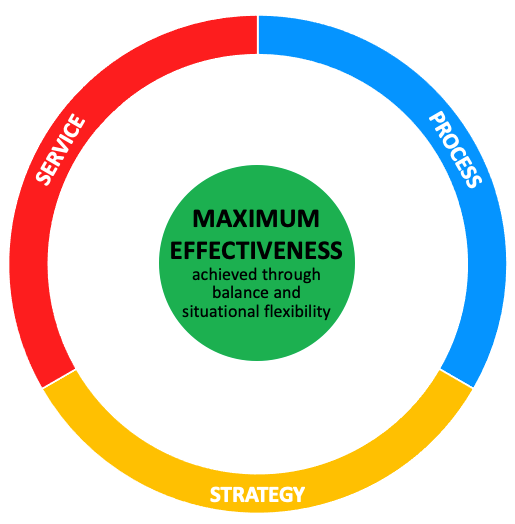
I’ve been on plenty of communications teams in my career. And I’ve come to learn there are, generally, three main ingredients for success:
Service
Process
Strategy
If your team can master those three skills, you’ll be operating at maximum effectiveness.
Here’s how it works:

Service
Service describes what your communications team does. Does your team write messages on behalf of executives? Or send messages to the field? That’s your service.
Process
Process describes how your team does the work. Do you require clients to submit a request form? Do you set up collaborative intake meetings with clients before the work begins? That’s your process.
Strategy
Strategy describes why your team does the work they do. Do you connect employees to the business so they can produce better results? Does your team manage the reputation of the business or one of its executives? That’s your strategy.
Easy. So what’s the big deal?
Now that you know the three ingredients for successful communications teams, do you do all three equally well, and easily flex between all three as needed?
The problem is, most teams tend to overuse one of these attributes while largely ignoring the other two.
Or worse yet, they’ve allowed themselves to be defined in their organization by one of these attributes alone, while being largely unassociated with the others. Since many leaders don’t always fully understand what internal communications teams do or the value they add, being narrowly defined as strictly one of these without the others can be dangerous. If we allow senior leaders who don’t have a clear understanding of internal communications to define us on their terms — by what they think we do — we leave our team’s existence at their mercy. More on that later …
Now, let’s look at examples of each of the three attributes and see if you can determine if your team is overusing — or being defined as — one of them.
Service team
A team that’s overusing the service attribute tends to do their work simply because someone wants it or needs it. They are doers and order takers who find their success simply by pleasing leaders.
The risk: Teams who are defined by their organization as “service teams”, and nothing more, aren’t always seen for the value they add, but because they do work others don’t want to do. When budgets get tight, service teams can find themselves on the chopping block if their work is deemed doable by an administrative assistant (or even AI), or able to be outsourced or split up among other teams.
Process team
A team that’s overusing the process attribute tends to anchor their value in the company’s org structure or compliance regulations. Work needs to “go through the communications team” because “that’s the rule.” They are seen by the rest of the company as part of the organization’s procedure for their own work to get done.
The risk: Teams who are defined by their organization as “process teams” can sometimes become the team people try to avoid when they need something done quickly. This type of communications team can be seen as a hinderance to other people’s work. Or, if your organization is highly regulated or process-driven, these types of communications teams can be seen strictly as a box to check, rather than a partner to collaborate with. And worst of all, if rules or org structures change, the entire team could be greatly downsized or even completely eliminated.
Strategy team
A team that’s overusing the strategy attribute tends to do their work simply because they’re protecting the integrity of the business’s, or an executive’s, reputation. These teams often seek the proper context, asking why the work should be done and ensuring they’re focused on the right work in the first place.
The risk: Teams who are defined by their organization as “strategy teams” can be sometimes be seen as difficult to work with because they might challenge the premise of the requests they receive. They often force clients to rethink their ideas and, if they don’t have a strong relationship with their clients, they can quickly become the team that no one wants to work with.
How do we know which type of team we are?
My favorite way to determine which type of team you are on (which attribute you’re overusing or defined by) is by what you most often say when you have to decline a request.
Here’s what I mean:
How a service team says “no”
If you have to decline work and your answer is “we just don’t have time” (or in corporate speak you might say “we don’t have the capacity to support that”) you could be operating as a service team.
If most of the time “not enough time or resources” is your reason for saying “no”, it’s likely because your team exists to do what others ask of you.
How a process team says “no”
If your answer is something like “your request is outside our standard practice” or “you didn’t meet our required deadline,” you might be a process team.
If a rule or standard practice is your go-to reason for saying “no” to requests, it’s probably because your team exists to fulfill some type of compliance requirement or organizational process.
How a strategy team says “no”
If your answer is something like “your request doesn’t align with the direction of the business (or an executive’s vision)” you could be a strategy team.
If that’s your only reason for saying “no”, it’s probably because your team exists to protect the reputation of the business or an executive.
So, which team should we strive to be?
You may be tempted to say, “we should strive to be a strategy team, right? After all, aligning with the business is why communications teams exist, isn’t it?”
But really the answer is: you should strive to be all of them. Your communications team’s maximum effectiveness is when you’re able to flex, as needed, between all three types of teams.
If your team is seen by your organization as solely one of these types of teams, that’s not good. Ultimately, you want your internal communications team to be known for their skills in all three of these areas.
If the company you work for sees your team as only filling one of these qualities, it will be easy to eliminate or reduce your team if, one day, that quality becomes no longer needed or valued. You should strive to be seen as valuable for your service, process and strategy, so if one of those becomes less valuable you still have the other two qualities to offer.
In the coming weeks, I’ll dive deeper into each attribute, and provide steps to help you find balance between service, process and strategy. And hopefully, together, we can start to improve how your team is perceived by your organization.
Subscribe to follow along!

Very insightful and interesting peeling back of the onion.